Chastity and Motherhood in Sanatana Dharma
Swami Vivekananda has said –
A race must first cultivate a great respect for motherhood, through the real sanctification and inviolability of marriage, before it can attain the ideal of perfect chastity.
Chastity is a great concept. Chastity is a powerful concept. Chastity essentially means refraining from any extramarital relationship. The relationship between the husband and wife is exclusive — from both sides. This is chastity.
If there is paativratya, then there is ekapatni vrata also. This is a form of tapas, a tapas with great spiritual benefits. Whenever we control a certain natural tendency within ourselves, whenever we exercise self-control, it leads to development of spiritual power. Spiritual growth.
Suppression is not self-control. In suppression, there is stress involved. You want to do something, but you are not able to due to social reasons — you want to have multiple affairs, multiple relationships — what will others think? This is suppression. Legal reasons — what if I get caught? Or even non-availability — you want to do something badly, but it is not available to you. You are dying to do it, but you are not able. This is suppression.
And rightly said, when you try to suppress something, it oozes out through every pore of your body. Given an opportunity where it can go unnoticed or when it is available, you would do it. This is suppression. This is negative.
Controlling an urge is positive. There is a resolve involved in it. There is a decision involved in it — yes, I am not going to take food for the next 24 hours. I will fight the urge. I will fight hunger and this is going to benefit me immensely.
When you do this consciously, with resolve, it makes you stronger. Your mind becomes stronger. Your will becomes stronger. You become a stronger person overall.
If you are suppressing, then it will make you depressed, frustrated. It is the same feeling that a soldier gets when he is risking his life, facing all kinds of hardships for the motherland — he feels proud. He won't feel a thing because it has a great cause behind it.
The same feeling you may not get in your daily life. In daily life, you will be sensitive towards even the slightest physical discomfort.
That is the big difference — the same between suppressing and self-control. In suppression, there is a compulsion. It is forced upon you against your wish. In self-control, there is satisfaction. There is a sense of achievement. Self-control is voluntary.
Western psychologists only say — don't suppress, don't suppress desires, emotions. That is animal living. That's because they don't understand spirituality. The power of spirituality. They are trying to understand ways and means of the mind. They have just begun.
Our sages have understood all about the ways and means of the mind and also mastered the mind. So our approach and their approach are different. They say, 'this is how the mind is.' We say, 'this is how the mind should be.' That is the difference.
Coming back to chastity — Swami Vivekananda says when three generations in a family observe chastity — pativratya and eka-patni vrata — then a great Brahmachari is born in that family.
Meaning: great-grandfather and great-grandmother should be chaste, absolutely loyal to each other; grandfather and grandmother should be chaste, absolutely loyal to each other; father and mother should be chaste, absolutely loyal to each other — then a great Brahmachari, not necessarily a boy — even a girl, someone with great wisdom, a visionary, someone who has his or her own mind and body under absolute control — such a child is born to them.
This is the power of a chaste husband-wife relationship. This is how great cultures are built. How great cultures evolve.
Not by throwing everything down the drain in the name of individual freedom and liberty. A culture which keeps the greatness of motherhood at its centre — that culture alone will survive.
We always had this in Sanatana Dharma. With the onslaught of western ideology — it is not even western ideology — they have realized their mistake and are throwing these concepts away. That's what we are picking up. What they are throwing away is what we are picking up in the name of individual liberty.
When motherhood is at the centre, then it is imperative that marriage should be sacrosanct. Marriage as an institution should be sanctified, it should be inviolable. Marriage, right from its first steps, should have divinity built into it. Purity built into it. Respect built into it.
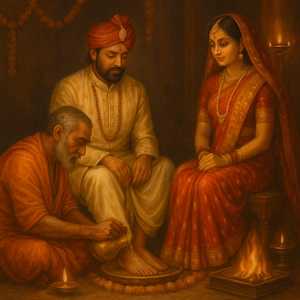
This is what our rituals do. The bride’s father considers the groom as Mahavishnu and washes his feet. The bride is told samrajnee bhava — 'you become an empress in your family.'
We are not talking about cohabitation of two beings for physical pleasure on a contract basis. We are talking about mutual dedication, mutual devotion, mutual respect — not just between husband and wife, but between the two families.
We are talking about evolving as a culture, growing — not regressing into primitivity, not regressing into animal existence — just satisfying carnal desires, just procreating.
For this, family is important, marriage is important, the stability of marriage is important, motherhood is important.
Our policymakers should have this clear in their minds. Rather than blindly mimicking legal developments in the West and elsewhere, we should not forget that we already have a well-developed culture of our own.
Any changes — social, legal — we should make sure that we are not in any way compromising or breaking down our rich culture and heritage. It has been built through thousands of years, through hundreds of generations.
In policymaking, due thought should be given to where we are heading as a culture, as a nation. Public interest litigations filed by activists and government acting out of compulsions of the outcomes of such PILs should not be the sole deciding factor of where we are heading as a nation, as a culture.
And one more thing — what is this motherhood being referred to here? This motherhood — not biological motherhood. This is a larger role.
There is a beautiful mantra which explains the scope and vastness of this motherhood — Sumangaleeyam. This is the mantra chanted when the bride reaches her marital home for the first time.
This mantra is addressed to the ladies in the neighbourhood:
'Oh Sumangalees, auspicious ladies — come and see this bride. Wish her sowbhagya, may she never be separated from sowbhagya. Oh Indra, bless her, bless her with fortune, bless her with children. Give her ten children and make her husband her eleventh child.'
The husband becomes one among her children. Gradually, eventually, the affection that she is going to develop towards her husband is motherly.
Can a contractual marriage ever contain within itself this great concept? The bride becomes the mother of not just her own children, but the whole family — including her husband.





English
Rare Topics
Click on any topic to open
7
30
Astrology
Bhagavad Gita
Bhagavatam
Bharat Matha
Devi
Devi Mahatmyam
Ganapathy
Garuda Puranam
Glory of Venkatesha
Hanuman
Kathopanishad
Mahabharatam
Mantra Shastra
Mystique
Practical Wisdom
Purana Stories
Radhe Radhe
Ramayana
Rare Topics
Rigveda Explained
Rituals
Sages and Saints
Shiva
Spiritual books
Sri Suktam
Story of Sri Yantra
Temples
Vedas
Vishnu Sahasranama
Yoga Vasishta
26
17
10
0


