Brahmana Dharma vs. Kshatriya Dharma
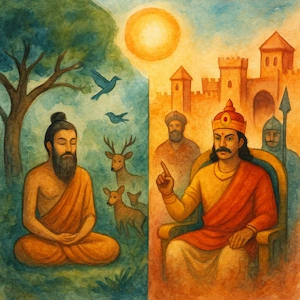
In the moral framework that defines Dharma as laid out in the Mahabharata’s Shanti Parva, few things are as vital as understanding the distinction between the Dharma of a Brahmana and that of a Kshatriya. These are not just social roles but two fundamentally different callings. Both are charged with the responsibility of sustaining cosmic balance, yet they do so through opposite approaches—one through renunciation, the other through assertion.
1. Two Paths, Two Fires
At the heart of Brahmana Dharma is the fire of jnana (spiritual wisdom). The Brahmana is inwardly focused, living a life of discipline, study, truthfulness, and ahimsa (non-violence). His strength lies in mental clarity and self-restraint. He is a keeper of sacred knowledge and a guide to others through counsel, austerity, and sacred rituals.
Kshatriya Dharma, on the other hand, is fueled by the fire of danda (righteous power). A Kshatriya is not permitted the luxury of withdrawal. His calling is to engage with the world—to fight, to protect, to govern. Courage, firmness, and decisiveness are his spiritual traits. He is the sword-arm of Dharma.
The difference isn’t about superiority; it’s about function. The Brahmana preserves the soul of Dharma; the Kshatriya protects its body.
2. Dharma of Renunciation vs. Dharma of Action
Brahmana Dharma is about stillness. It cultivates virtue by minimizing worldly involvement. It is a path of tapas (austerity), contemplation, scriptural study, and the pursuit of moksha (liberation). Violence is foreign to this path. A Brahmana conquers through silence, prayer, and self-discipline.
Kshatriya Dharma is about motion. It cultivates virtue through righteous action. For a Kshatriya, to avoid action in the name of peace is itself a sin. He is called to fight when adharma arises. If he withdraws from duty, he is not praised for restraint—he is condemned for neglect.
In essence, what is dharma for the Brahmana becomes adharma for the Kshatriya, and vice versa.
3. The Cosmic Role of Danda
The most profound concept in the text is Danda—not merely as punishment, but as the sacred force of justice. It is said to be created by the Supreme Being, infused with the fire of Brahma, and meant to uphold the moral spine of the universe.
For the Brahmana, Danda is not to be wielded. His tools are words and wisdom.
For the Kshatriya, Danda is his scepter, his dharma, and his tapas. He must use it—not out of personal vengeance but as a sacred duty to restrain the wicked and protect the virtuous.
Danda, when wielded rightly, brings peace, prosperity, and balance. When wielded wrongly—or abandoned—it destroys not only the king but also his kingdom. It is described as a divine fire: it warms and protects when handled with discipline, but burns and annihilates when mishandled.
4. Authority is a Divine Responsibility
The king, representing Kshatriya Dharma, is no mere mortal ruler. He is seen as a composite of the gods—born from the essences of Agni, Vayu, Surya, Yama, Indra, and others. He is Tejas incarnate, a blazing force of divine will. His authority is not earned by lineage or conquest alone—it is sanctioned by Dharma.
Yet this authority is conditional. If the king strays from Dharma—if he becomes weak, greedy, unjust, or fearful—the very power that once protected him will now destroy him. Danda is unforgiving to those who are unworthy to hold it.
Thus, Kshatriya Dharma is not about enjoying power—it is about bearing the sacred burden of responsibility, vigilance, and self-conquest.
5. Purity vs. Power: Who Protects Whom?
The Brahmana protects the purity of Dharma’s intent; the Kshatriya protects its application in the real world. One must guide, the other must act. A society without Brahmanas forgets its ideals. A society without Kshatriyas loses its strength and collapses into chaos.
If Brahmana Dharma focuses on inner order (ethics, knowledge, discipline), Kshatriya Dharma ensures outer order (law, security, leadership). The former thrives in ashramas and yajnas. The latter thrives in courts, battlefields, and assemblies.
Neither is complete on its own.
6. Justice as Worship
When a Brahmana performs yajna, it nourishes the gods.
When a Kshatriya enforces justice, it nourishes the world.
Ruling justly, defending the weak, punishing the aggressor—these are not worldly acts for a king. They are his spiritual offering. His battle is his yajna. His throne is his altar. The poor, the vulnerable, and the sages are his sacred charges.
By punishing the wicked and protecting the noble, the Kshatriya earns not sin but merit. Even violence becomes holy when it is aligned with Dharma.
7. When Dharma is Violated
The text makes it brutally clear: when a ruler does not uphold Danda, society collapses into Matsya Nyaya—the law of the jungle, where the strong devour the weak. Boundaries are destroyed. Temples are desecrated. The sacred and the profane become indistinguishable.
Even divine beings like Devas and Gandharvas remain in order only because of fear of Danda. It is a universal principle that spans all realms. The king, then, is not just the ruler of a kingdom; he is a guardian of cosmic alignment.
Conclusion
Brahmana Dharma is about preserving Dharma’s purity.
Kshatriya Dharma is about enforcing Dharma’s power.
If the Brahmana forgets self-restraint, he becomes arrogant.
If the Kshatriya forgets justice, he becomes weak or tyrannical.
Each must stay rooted in their own path. When the Brahmana tries to rule through inaction, he fails. When the Kshatriya tries to imitate the Brahmana by withdrawing into silence after battle, he commits adharma. The Mahabharata declares it clearly: Justice is the Kshatriya’s sacrifice; rulership is his penance; and action is his path to heaven.






English
Rare Topics
Click on any topic to open
7
30
Astrology
Bhagavad Gita
Bhagavatam
Bharat Matha
Devi
Devi Mahatmyam
Ganapathy
Garuda Puranam
Glory of Venkatesha
Hanuman
Kathopanishad
Mahabharatam
Mantra Shastra
Mystique
Practical Wisdom
Purana Stories
Radhe Radhe
Ramayana
Rare Topics
Rigveda Explained
Rituals
Sages and Saints
Shiva
Spiritual books
Sri Suktam
Story of Sri Yantra
Temples
Vedas
Vishnu Sahasranama
Yoga Vasishta
26
17
10
0


