Brahma Is Like a Product Development Head of a Company
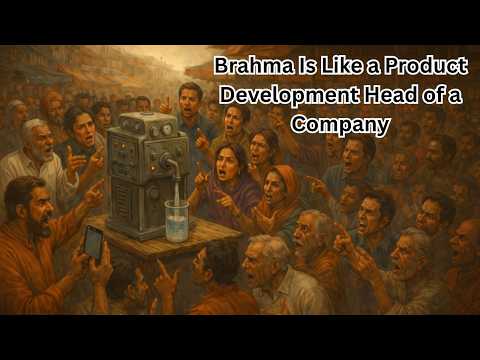
Do you know how Brahma creates?
Whatever Brahma has to create, they are all non-existent.
So, the CEO of a company calls his product development head and says, 'Make a machine which can take hydrogen and oxygen from the air and make water.'
This product will have good demand.
Brahma also gets such a mandate to create the universe which is non-existent.
Now, a product development head — what all resources will he need?
First of all, ideas, thoughts, knowledge.
But where will they all sit? In the product development department, they will sit in the minds of all the team members.
These minds are like containers which will hold thoughts, ideas, and knowledge.
The product development head will constitute a team which is essentially a collection of containers called minds.
There, Brahma also creates something called mind — the universal mind — first of all.
Then the ideas and knowledge.
In what format do ideas and thoughts and knowledge exist within the minds of the product development team and even the head? As words.
Even when it is an image, let’s say the contours of the product, it has corresponding words.
Even if you are narrowing down the image to binary system, still you need 0 and 1, which are words.
So, minds as containers and ideas as words.
There, Brahma also creates vak — words, speech.
The universal speech which is Veda.
Now, the product development team will need materials to make the product out of, and energy to cut, to blend, and even energy for the people to be active, to be able to work.
Since matter and energy are one and the same — since matter is just dense energy — e = mc² — we can use the term energy to represent both matter and energy.
This includes all actions and activities also.
There, Brahma will have prana — the universal energy.
Until now, the product development team has:
-
Minds
-
Thoughts, ideas, and knowledge as words
-
Energy — as energy and materials, also actions
Brahma has:
-
Universal mind called manaha
-
Words called vak
-
Energy called prana
The same. Only the scale is different.
The team has to make just one product.
Brahma has to make the whole universe.
Now both the product development team and Brahma successfully complete their job.
The team has the water maker ready.
Brahma has the universe ready.
But except the team, nobody knows about the water maker.
Except Brahma, nobody knows about the universe.
Water maker exists, universe exists.
This pure state of existence — where nobody can judge, say this is wonderful, this is not so good, this is very expensive — it is not yet open for such judgement, comments, or opinions.
This state of pure product — this is called ananda as in sacchidananda.
In this state, the pure bliss that the development team would feel — 'Yes, we have done it' — only that exists. Ananda.
There is no one else to make any comment.
It is pure product only.
Same experience for Brahma and the team — ananda.
Now the product is to be launched.
It has to come to existence in the market.
Then only it will serve any practical purpose, right?
It is developed so that it is used.
When the product is launched, it comes to existence.
Earlier also it was there, but not available for the public.
Now it is available for the public.
It can be purchased, used — this coming into existence is called sat as in sacchidananda.
But this sat has a problem.
Now it is exposed to judgements, comments, reviews.
The product will be spoken about in social media.
Somebody will say it is value for money.
Somebody will say it doesn't work.
Somebody will say it is great, it’s a boon for areas where there is deficiency of water.
Now it will boil down to individual impression and perception.
The same product will be described and judged in thousand different ways.
There is no common conclusion.
This will go on getting more and more complex as time proceeds.
But they exist.
The product is now downgraded from that pure product to something with so many judgements, comments, perceptions attached to it.
But you can't wish them away.
Or you should have never launched the product.
You should have kept it hidden from everyone.
Now that it is open in the public, it is bound to happen.
Even though many of these opinions may not be true, they still exist.
This state is the sat in sacchidananda.
When the opinions and comments and judgements are removed, it becomes pure product.
If you want, you can call this as sat which is equal to ananda,
and the impure product with comments and judgements as asat.
It is just a matter of how you want to consider the physical world — as real or unreal.
I would myself prefer to consider that the physical world is real.
It is only our understanding about the physical world that is incomplete or even wrong.
Then the third component of sacchidananda — the chit.
Chit means the knowledge about the product.
People are able to see the product, touch it.
They get a user manual.
That is how they are able to use it.
If people don't have eyes, ears, mind, intelligence — then they will not even be able to see the product.
They will not even be aware of the product.
This awareness is the chit in sacchidananda.
See how simple it is.
This is because what Brahma does cannot be out of the world.
There can't be any mystery.
Because what he does is part of the world.
We should be able to understand it.
Question 1: Why must the Creator first establish a Universal Mind before bringing physical matter into existence?
Just as a product development head needs a department to house thoughts and plans, the Creator needs a container for the blueprints of reality. This Universal Mind, or Manaha, acts as the workspace. Without a mental field, ideas have no place to reside. The mystery here is that the universe exists as a thought before it exists as a thing. This implies that the foundation of our physical world is actually mental and conceptual.
Question 2: What is the secret connection between ancient Vedic Speech and modern binary coding?
The text suggests that all ideas and forms are eventually reduced to words or sounds, known as Vak. Just as a modern computer renders complex 3D images through a language of zeros and ones, the Creator uses the Veda as a primordial code. The secret is that vibrations and names are the software of the universe. Matter is simply the hardware that runs the program written in the language of the Universal Speech.
Question 3: How does the principle of Prana bridge the gap between a thought and a solid object?
Prana is the universal energy that serves as both the fuel for action and the substance of matter. Following the logic of energy and mass being interchangeable, Brahma uses Prana to densify ideas into physical reality. The greatness of this principle lies in the realization that there is no division between the worker, the work, and the material. It is all one energy vibrating at different frequencies.
Question 4: Why is the state of completion described as Ananda or pure bliss before the universe is perceived by others?
Ananda represents the state of a finished product that is perfect in its own right, free from external validation or criticism. This is the secret of internal fulfillment. In this state, the product is pure because it hasn't been filtered through the biased lenses of observers. It is the bliss of pure achievement where the creator and the creation exist in a perfect, silent harmony.
Question 5: What is the mystery behind the transition from Ananda to Sat?
The transition occurs when the product is launched or made manifest. Sat is the state of existence in the public eye. The mystery is that while the product remains the same, its entry into the world creates a duality. It becomes available for use, but it also becomes vulnerable to the noise of the world. This transition shows that for anything to be useful, it must move from the silent state of perfection into the noisy state of existence.
Question 6: Why does the physical world seem complex and confusing if it originated from a pure state?
The complexity is not in the object itself, but in the thousands of individual perceptions, judgments, and reviews attached to it. The text calls this the downgrade from a pure product to a perceived one. The secret to understanding reality is to strip away these layers of opinions and social media style commentary to see the pure product as it was intended by the Creator.
Question 7: What is the role of Chit in helping us navigate the created universe?
Chit is the consciousness or awareness that acts as the user manual for the universe. Without Chit, the universe would exist, but it would be invisible and unusable to us. It provides the intelligence and the senses required to interact with the creation. The greatness of this principle is that the Creator did not just provide a world, but also provided the consciousness necessary to experience and understand it.
Question 8: Is the physical world unreal, or is there a deeper secret regarding its existence?
It requires a balanced view. While some philosophies call the world an illusion, this perspective suggests that the physical world is real, but our understanding of it is often wrong or incomplete. The illusion, or Asat, consists of the false judgments and distorted perceptions we project onto the world. The secret is that the world is real; it is our mental commentary that is often unreal.
Question 9: How does the scale of Brahma's work compare to human innovation?
The principles are identical; only the scale differs. A human team creates a single machine like a water maker, while Brahma creates the entire mechanism of the stars, planets, and life. The mystery revealed here is that the laws of creativity are universal. Whether you are building a startup or a galaxy, you require a mind to hold the idea, a language to define it, and energy to manifest it.
Question 10: What is the ultimate takeaway for a person trying to understand the nature of reality?
The ultimate secret is that there is no mystery beyond our reach because the Creator’s process is mirrored in our own daily lives. By observing how we bring a project from an idea to a finished product, we can understand how the entire universe was formed. We live within a divine product launch, and our goal is to use our awareness to see the pure Ananda that lies beneath the surface of the world’s many opinions.






English
Mystique
Click on any topic to open
7
30
Astrology
Bhagavad Gita
Bhagavatam
Bharat Matha
Devi
Devi Mahatmyam
Ganapathy
Garuda Puranam
Glory of Venkatesha
Hanuman
Kathopanishad
Mahabharatam
Mantra Shastra
Mystique
Practical Wisdom
Purana Stories
Radhe Radhe
Ramayana
Rare Topics
Rigveda Explained
Rituals
Sages and Saints
Shiva
Spiritual books
Sri Suktam
Story of Sri Yantra
Temples
Vedas
Vishnu Sahasranama
Yoga Vasishta
26
17
10
0


