Bhokta
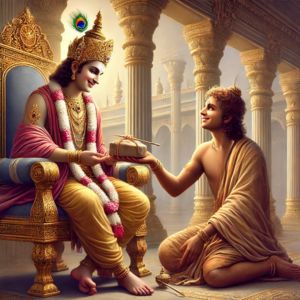
Let’s look at the meaning of the 145th divya nama of Vishnu Shasranama - Bhokta (भोक्ता) from -
भ्राजिष्णुर्भोजनं भोक्ता सहिष्णुर्जगदादिजः ।
अनघो विजयो जेता विश्वयोनिः पुनर्वसुः ॥
The divine name 'Bhokta' means 'The Enjoyer.' It shows that Lord Vishnu Himself is the one who enjoys or accepts the offerings made by His devotees. These offerings could be simple items like leaves, flowers, fruits, or water, but when given with true love and devotion, He accepts them as priceless treasures.
Bhagavad Gita says:
पत्रं पुष्पं फलं तोयं यो मे भक्त्या प्रयच्छति।
तदहं भक्त्युपहृतमश्नामि प्रयतात्मनः।।
(Gita 9.26)
'If a devotee offers to me a mere leaf, flower, fruit, or water with sincere devotion and love, I accept it as an invaluable treasure.'
The name 'Bhokta' also signifies that Lord Vishnu accepts and enjoys all offerings, no matter which deity they are intended for. This means He is the ultimate receiver of all offerings, showing His all-encompassing nature and His grace towards those who serve Him with love.
In this way, 'Bhokta' emphasizes Vishnu’s role as the one who lovingly accepts the devotion and sacrifices of His devotees, bringing them closer to Him.
1. Gajendra Moksha
- In the story of Gajendra Moksha from the Bhagavata Purana, the elephant Gajendra was caught by a crocodile and struggled fora long time. When he finally offered a lotus to Lord Vishnu with a sincere prayer, Bhagavan appeared instantly, accepting his offering and devotion. Vishnu's acceptance of Gajendra's lotus shows that He values love and sincerity above all else.
- Despite being a mere flower, this lotus became invaluable because it was offered with deep faith. This story emphasizes that Vishnu, as the ultimate Bhokta, treasures sincere devotion over material richness.
2. Draupadi’s Akshaya Patra Offering
- In the Mahabharata, when the Pandavas were in exile, Draupadi used the Akshaya Patra, a magical vessel that provided unlimited food until she ate her portion. One day, when Sage Durvasa and his disciples visited, the pot was empty. The pot once emptied and washed will not produce food for the rest of the day. Draupadi prayed to Lord Krishna for help. Krishna accepted a single grain of rice that she could still find inside the pot, and, as Bhokta, He was satisfied. This satisfaction filled the stomachs of the sage and his disciples.
- This example shows that even a single grain, offered with devotion, is enough for the Lord, who is truly the Bhokta of all offerings made with love.
3. Sudama’s Beaten Rice (Poha)
- Another famous story is that of Sudama, Lord Krishna’s childhood friend. Sudama, a poor Brahmin, visited Krishna with a small bag of beaten rice (poha). Despite the simplicity of this offering, Krishna accepted it with great joy and affection. In return, He blessed Sudama with wealth and prosperity.
- This episode demonstrates that Lord Vishnu, as Bhokta, cherishes the smallest gifts given with a pure heart. His joy in receiving the humble gift from Sudama shows His loving nature toward His devotees.
4. Rama’s Acceptance of Sabari’s Berries
- In the Ramayana, Lord Rama met Sabari, a humble devotee, who offered Him berries. She tasted each berry first to ensure they were sweet before offering them to Rama. Despite this act, considered impure by societal norms, Rama accepted the berries because of Sabari’s deep devotion and love.
- This story illustrates that Lord Vishnu values love and devotion over ritual purity, as He accepted Sabari’s berries wholeheartedly. It exemplifies His role as Bhokta, one who is pleased by sincere offerings.
5. Devaki and Vasudeva’s Prayers
- In the Bhagavata Purana, when Lord Krishna was born to Devaki and Vasudeva in the prison of Kamsa, they offered prayers and surrendered completely to Him, asking for His grace. Lord Vishnu accepted their heartfelt prayers, promising to protect them and fulfill His role as their son.
- Here, Lord Vishnu accepts not material offerings but the deep faith and surrender of His devotees. This shows that as Bhokta, He also 'enjoys' or accepts prayers, surrender, and devotion, not just physical offerings.
6. The Bhagavad Gita – Universal Bhokta
- In the Bhagavad Gita, Lord Krishna declares, 'I am the enjoyer of all yajnas and the Lord of all the worlds.' This statement signifies that even offerings made to other deities ultimately reach Him. This universal acceptance as Bhokta shows Vishnu’s all-encompassing role as the divine recipient of all acts of devotion across the cosmos.
- It emphasizes that Lord Vishnu is the ultimate Bhokta, accepting all sacrifices, worship, and offerings, regardless of the form or the deity to whom they are dedicated.
Significance of 'Bhokta' in Devotees' Lives
- The name 'Bhokta' reassures devotees that Bhagavan cherishes their offerings, however small, as long as they are given with a sincere heart. His acceptance brings blessings, peace, and fulfillment to devotees.
- It reminds followers that what matters most to the Lord is not the size or type of offering but the purity of intention behind it. This encourages devotees to worship with love rather than worrying about material wealth or ritual perfection.
Through these examples, we see that as Bhokta, Lord Vishnu shows His boundless love and grace, rewarding the devotion of His followers, no matter how simple or humble their offerings might be. His role as the 'Enjoyer' brings devotees closer to Him, teaching us that heartfelt devotion is the true path to His divine blessings.
-
Why does it matter that the Lord is called the enjoyer of offerings?
Because it shifts focus from the object to the devotion. A leaf or a grain becomes priceless when offered with love. Chanting any nama from the Vishnu Sahasranama reminds us that Bhagavan looks at intention, not size, and this outlook keeps both family giving and personal humility balanced. -
If He accepts even the smallest gift, why do people still offer elaborate rituals?
Rituals discipline the mind and body, but their value lies in devotion. The Lord as Bhokta accepts both the feast and the single grain when offered with sincerity. Reciting the Sahasranama slowly helps us remember this truth daily, making our family rituals meaningful rather than mechanical. -
How can accepting even impure or broken norms, like Sabari’s berries, make sense?
Because purity of heart outweighs rules. The berries carried her love, and that was enough. Chanting any nama from the Sahasranama keeps us rooted in this principle, guiding us to value sincerity in our relationships too, rather than appearances alone. -
What does it mean that He is the enjoyer of all yajnas, even those to other deities?
It means all worship flows back to the same source. Bhagavan is the hidden center who receives all devotion. Chanting 108 repetitions of any nama from the Sahasranama aligns us with this truth, strengthening harmony in both faith and family. -
Why highlight stories of simple offerings like rice, lotus, or berries?
Because they show that heartfelt giving transforms ordinary items into divine gifts. The Lord as Bhokta accepts them with joy. Regular nama japa, even 11 times when pressed for time, keeps us in that same spirit of simplicity, teaching families that love matters more than wealth. -
How does this idea of Bhokta affect everyday life?
It assures us that nothing given with love is wasted. A kind word, a small help, or a meal shared all reach the Lord. Chanting the Vishnu Sahasranama together as a family strengthens bonds, keeps hearts pure, and even benefits health by reducing stress and bringing peace.
-
Why call Vishnu the enjoyer when He clearly cannot eat or drink?
Enjoyment here means acceptance, not physical consumption. The point is that the intention of devotion transforms the act, and He validates it by making it spiritually significant. Stories like Gajendra’s lotus or Sudama’s rice show this meaning in action. -
How can one grain of rice or a single flower be enough for a deity said to rule the universe?
The grain or flower is symbolic; it represents the devotee’s surrender. When offered with love, it carries infinite weight because it reflects inner truth, not material value. That is why even the smallest gift becomes acceptable. -
Isn’t it contradictory that He accepts offerings to other gods too?
The idea is that all offerings in the system of worship ultimately converge to the same source. If Vishnu is the preserver of creation, then He is by definition the underlying receiver of all devotion. This is a theological explanation of unity beneath diversity. -
Why highlight examples of impure or socially unacceptable offerings, like Sabari’s berries?
Because they show that sincerity trumps ritual formalities. The story demonstrates that love and faith carry more weight than external rules. Purity of devotion was the real content of the offering, not the berries themselves. -
If He is truly the enjoyer, what does He gain from it?
He gains nothing in material terms. The gain is for the devotee, whose offering is sanctified by His acceptance. The relationship is built not on need, but on recognition of love and surrender. -
How can prayers alone count as offerings without any physical gift?
Because surrender and faith are treated as offerings of the heart. Devaki and Vasudeva had nothing but prayer in prison, yet their devotion was accepted. This shows that inner offering is considered equal to outer offering.





English
Vishnu Sahasranama
Click on any topic to open
7
30
Astrology
Bhagavad Gita
Bhagavatam
Bharat Matha
Devi
Devi Mahatmyam
Ganapathy
Garuda Puranam
Glory of Venkatesha
Hanuman
Kathopanishad
Mahabharatam
Mantra Shastra
Mystique
Practical Wisdom
Purana Stories
Radhe Radhe
Ramayana
Rare Topics
Rigveda Explained
Rituals
Sages and Saints
Shiva
Spiritual books
Sri Suktam
Story of Sri Yantra
Temples
Vedas
Vishnu Sahasranama
Yoga Vasishta
26
17
10
0


