Bhagavad Gita Shloka 39 Chapter 2
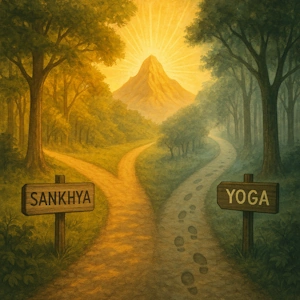
एषा तेऽभिहिता सांख्ये बुद्धिर्योगे त्विमां शृणु।
बुद्ध्यायुक्तो यया पार्थ कर्मबन्धं प्रहास्यसि।।2.39।।
eshaa te'bhihitaa saankhye buddhir yoge tv imaam shrinu
buddhyaa yuktah yayaa paartha karmabandham prahaasyasi
Meaning:
Krishna says — Till now, I taught you the wisdom of Sankhya — the knowledge of the Self that frees one from sorrow. Now, hear about the buddhi of Karma Yoga — the practical path of detached action — which, when followed with steadiness, will break the bondage of karma and lead you to the same liberation.
Explanation:
Krishna isn’t just dropping isolated ideas. He’s building a scaffold — brick by brick — so Arjuna (and through him, all of us) can climb from confusion to clarity.
Up till now, Krishna spoke of Sankhya — the purest jnana, the vision of the Self, untouched by death, beyond all sorrow. But now, He shifts.
Why?
Because He knows His listener.
Arjuna is a kshatriya, a man of action, standing in the chaos of battle. Knowledge alone won’t lift him — he needs a bridge between knowing and doing.
So Krishna says:
Arjuna, I just gave you the vision — now hear how to live it. Not in a cave, but in Kurukshetra.
This verse is like Krishna saying —
I’ve shown you the summit (Sankhya). Now let Me teach you the path to reach it (Yoga).
That’s why He introduces two distinct disciplines —
- Sankhya for the jnanis — the contemplative, the seers
- Yoga for the karmis — the doers, who act with detachment and devotion
This separation is not division — it’s clarity.
Without it, the listener might get lost — thinking jnana and karma are contradictions. But Krishna, with poetic brilliance, prepares the ground:
Understand the subject clearly now — so that later, when I speak of the twofold path (jnanayoga and karmayoga), you won’t get confused.
And then He praises the next path:
This Yoga — when done with the right buddhi, the right inner balance — will free you from the bonds of karma itself. Even in action, you’ll taste liberation.
Highlights from traditional commentaries:
Sri Abhinavagupta
He highlights that if one performs action as their natural duty (svadharma), even amidst pleasure and pain, it never becomes sinful. Action aligned with one’s nature and performed without ego leads to inner freedom, not bondage.
Sri Jayatirtha
Jayatirtha provides a highly philosophical and polemical clarification — distinguishing the Gita’s use of the terms Sankhya and Yoga from their usage in Kapila's or Patanjali’s systems. He defends that here, Sankhya refers to the Vedantic pursuit of Self-realization, not mere analytical dualism. He thoroughly dismisses misinterpretations and affirms that Krishna's usage is grounded in Upanishadic wisdom.
Sri Madhusudan Saraswati
Madhusudana beautifully resolves the tension between jnana and karma. He says Arjuna, being afflicted by impurities of the mind, cannot directly absorb Self-knowledge. Hence, Krishna introduces Karma Yoga as a necessary preparatory path. Detached action purifies the mind and removes obstacles to knowledge — which alone can destroy the root of karma.
Sri Purushottamji
He explains that Sankhya here means direct knowledge of Self. If Arjuna hasn’t realized that even after hearing, then Karma Yoga must be embraced as a tool to purify the mind and make it ready for realization. Actions done with surrender lead to liberation from karma.
Sri Shankaracharya
Shankara interprets Sankhya as Self-knowledge — the direct cause for freedom from sorrow and delusion. Since Arjuna is not ready yet for that, Krishna introduces Yoga — detached, duty-bound action — as the path to attain that very knowledge. It’s a strategic shift, not a contradiction.
Sri Vallabhacharya
Vallabha sees Krishna using this verse to gently transition Arjuna from liking just jnana to embracing Karma Yoga too. Even if one enjoys philosophical clarity, action rooted in dharma is essential. With the right buddhi, one escapes both good and bad karmic bonds.
Sri Anandgiri
Anandagiri dives into why Krishna mixes jnana and karma here — not to confuse, but to guide. He says this verse sets up a logical and structured presentation of dual paths (jnana and karma) for different adhikaris (qualified individuals), which Krishna will elaborate soon.
Sri Dhanpati
He defends the placement of this verse as a transition — showing how Self-knowledge leads to detachment, and Karma Yoga helps remove impurities that block that knowledge. He rebuts the idea that karma can't lead to freedom, saying it becomes a gateway to knowledge.
Sri Madhavacharya
He equates Sankhya with direct knowledge of the Self. He distinguishes Gita's Yoga from Patanjali Yoga, saying Karma Yoga here is a sacred means to purify and elevate. The goal is not mere action, but dispassionate, steady-minded action that leads to liberation.
Sri Neelkanth
Neelkanth explains that this verse reconciles what looks like a contradiction — how the eternal, non-acting Self can be told to fight. He says this is possible due to difference in qualification: for an impure mind, Karma Yoga is the path; for a pure one, Jnana Yoga.
Sri Ramanuja
Ramanuja defines Sankhya as the intellect fixed in Self-awareness. He points out that Karma Yoga, when offered to God and done without selfishness, becomes a sacred way to attain Self-knowledge and dissolve the bondage of karma.
Sri Sridhara Swami
Sridhara interprets this verse as Krishna saying: Even if you haven’t grasped Self-knowledge fully, don’t worry — start with Karma Yoga, and the clarity will come. When done with devotion and equanimity, karma burns its own seeds.
Sri Vedantadeshikacharya (Venkatanatha)
He lays out the verse’s structure and says: Self-knowledge (Sankhya) was introduced first to set the philosophical base. But because Arjuna is not yet ready, Krishna now shifts to Karma Yoga as the suitable discipline to purify the heart and prepare for realization.





English
Bhagavad Gita
Click on any topic to open
7
30
Astrology
Bhagavad Gita
Bhagavatam
Bharat Matha
Devi
Devi Mahatmyam
Ganapathy
Garuda Puranam
Glory of Venkatesha
Hanuman
Kathopanishad
Mahabharatam
Mantra Shastra
Mystique
Practical Wisdom
Purana Stories
Radhe Radhe
Ramayana
Rare Topics
Rigveda Explained
Rituals
Sages and Saints
Shiva
Spiritual books
Sri Suktam
Story of Sri Yantra
Temples
Vedas
Vishnu Sahasranama
Yoga Vasishta
26
17
10
0


