Before They Called, He Knew
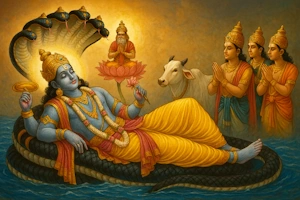
पुरैव पुंसावधृतो धराज्वरो भवद्भिरंशैर्यदुषूपजन्यताम् ।
स यावदुर्व्या भरमीश्वरेश्वरः स्वकालशक्त्या क्षपयंश्चरेद्भुवि ॥
-Srimad Bhagavatam - 10.1.1.22
'The Supreme Lord, the Master of all lords, had already understood the Earth’s suffering long before it was spoken aloud. He decided that you (the gods), through your partial expansions, should take birth among the Yadus. Meanwhile, He Himself would descend to Earth and, moving among humans, destroy its burden using the power of His own divine time-energy.' - These are Brahma’s words.
Bhumi Devi, burdened by evil rulers, took the form of a cow and approached Brahma for help. Brahma along with Devas and Rishis went to Kshira Sagara and praised Sriman Narayana with Purusha Sukta. Bhagavan, already knowing this beforehand, had made His plan: He would descend Himself and lighten the burden of Earth by incarnating among the Yadus.
1. Bhagavan doesn't wait to be told
Before Bhumi Devi even complains, Bhagavan already knows the situation. Why? Because He is Sarvajna, the all-knowing. He is aware of the distress even before it is voiced.
This highlights that the Lord doesn’t wait for our cries — He watches, He knows, and sometimes, He even acts before we call out. That’s divine grace.
2. Bhagavan’s command is already issued
He doesn't just wait to show mercy — He already gives the command: 'I will incarnate among the Yadus.' He decides to take a human form to restore dharma.
Here, Bhagavan is planning to enter Earth as one of us, not just as a divine being floating in the sky — but as someone who feels, laughs, lives, fights, and loves like us.
3. Earth’s burden = the Adharmic kings
The 'burden' is not just the weight of evil people, it’s the injustice, violence, and corruption caused by rulers who have lost all sense of righteousness. This is what's tearing the fabric of dharma.
4. Bhagavan's incarnations are purposeful
He never incarnates just for display. Every avatara has a precise goal. In this case: to relieve Bhumi Devi, destroy evil kings, and revive dharma.
And for that, He takes the form of Krishna, born into the Yadu dynasty, which was full of devotees and powerful warriors — the perfect support system for His mission.
5. Why Yadus?
Krishna didn’t take birth randomly. He chose the Yaduvamsha because they were His own — His true devotees, people who were qualified to handle and serve Him in His human form.
He wouldn’t take birth in a place where He would be disrespected or misunderstood. He chooses His environment wisely.
6. Who can truly act?
Only that being can truly act who is independent of time — one who isn't bound by death or karma. And that’s only the Ishwara of all Ishwaras — Krishna Himself.
Even Brahma, Vishnu, Shiva — they function within limits. But Krishna alone is beyond time, space, karma, and creation.
So only He can take on such a massive task of restoring cosmic balance.
7. Plea to the Lord
'Hey Bhagavan! Hey our eternal master! Please come soon. Don’t delay. If You don’t come, who else can save us?'
It’s raw. Emotional. Like a child crying for his parent in a storm.
Takeaways
This isn’t just about Krishna’s birth — it’s a template for divine intervention.
- Bhumi Devi cries.
- The Devas are worried.
- Brahma looks for a solution.
- The Lord already knows.
- He doesn’t hesitate.
- He decides where, how, and in whom to incarnate.
And He does it not just to destroy evil, but to bring joy, to give darshan, to show love — to be with us, among us.
- Why did Bhumi Devi choose the form of a cow specifically when approaching Brahma for help?
The cow is the ultimate symbol of selfless giving, patience, and vulnerability in Vedic thought. By appearing as a cow, Bhumi Devi signaled that the Earth was being milked dry and exploited by adharmic rulers rather than being protected. It was a silent plea for a protector, as the cow is the animal most dependent on the righteous guardianship of a king or herdsman. - What is the significance of the phrase Ishwareshwarah (the Master of all lords) in this context?
This title establishes that while Brahma, the Devas, and even the administrative forms of Vishnu have their specific roles and jurisdictions, Krishna is the source of them all. It clarifies that the upcoming incarnation is not merely a local deity responding to a local crisis, but the Absolute Reality itself descending to recalibrate the entire cosmic order. - The text says Bhagavan already understood the Earth's suffering before it was spoken. What does this reveal about the nature of prayer?
It reveals that prayer is not for the purpose of informing God about our problems, as He is Sarvajna (All-knowing). Instead, prayer is a process of aligning our will with the Divine and preparing our hearts to receive the grace that is already being offered. Bhumi Devi’s approach was the formal catalyst for a plan that the Lord had already set in motion in the eternal dimension. - Why is the Lord described as destroying the burden of Earth using His own divine time-energy (Sva-kala-shaktya)?
This is a hidden aspect of the Avatara's work. While we see Krishna fighting battles with weapons, the true "killing" of evil is done by Time itself. The Lord is Kaala (Time). By descending into the world of time, He accelerates the natural decay of evil and ensures that adharma collapses under its own weight at the precise moment required for cosmic balance. - What is the mysterious reason behind the command for the Devas to take birth among the Yadus?
An Avatara does not act in a vacuum; He creates a divine ecosystem. By ordering the Devas to take partial expansions (amsha) as Yadus, the Lord ensured that the social environment surrounding Him would be composed of beings who possessed divine qualities. This hidden layer shows that the Lord’s "human" play is actually a celestial drama where every participant is a high-level consciousness serving a specific purpose. - Why is it emphasized that the Lord would move among humans (chared bhuvi) rather than appearing in a terrifying or supernatural form?
The "burden" of the Earth is often the psychological distance between the Creator and the created. By moving as a human, the Lord makes Himself accessible. He destroys evil not just through power, but by providing a personal example of Dharma that humans can relate to and follow. It is a descent of love as much as it is a descent of justice. - How does the choice of the Yadu dynasty illustrate the principle of reciprocity in devotion?
The Yadus were known for their unalloyed devotion and were often persecuted by tyrants like Kamsa. By choosing to be born among them, the Lord demonstrates that He is Bhakta-vatsala (one who is very affectionate toward His devotees). He validates their suffering and rewards their lineage with the highest honor possible, showing that He "belongs" to those who have surrendered to Him. - What is the difference between the "weight" of the Earth and the "burden" mentioned in the verse?
The physical weight of the Earth is never an issue for the Lord. The "burden" refers to the metaphysical heaviness caused by the arrogance of rulers who think they are the ultimate enjoyers. This arrogance creates a disharmony in the subtle energy of the planet. The Lord’s mission is to remove the "ego-burden" of the world, restoring its natural lightness and joy. - Why did Brahma lead the group to the Shore of the Milk Ocean (Kshira Sagara) specifically?
The Milk Ocean represents the state of pure Sattva (goodness) where the Lord resides as the maintainer of the universe (Kshirodakashayi Vishnu). It symbolizes that when the world is in chaos, one must return to the source of purity and maintenance to find a solution. It is the spiritual "control room" where the preservation of the universe is managed. - If the Lord knows everything and acts through His power, why is the emotional "plea to the Lord" by devotees still considered necessary?
The plea is the "bridge" between divine sovereignty and human experience. While the Lord is independent, He chooses to be "bound" by the love of His devotees. The raw, emotional cry of the devotee provides the "excuse" for the Lord to manifest His Lila (divine play). It transforms a mechanical correction of the universe into a beautiful, heart-centered relationship between God and His people.





English
Bhagavatam
Click on any topic to open
7
30
Astrology
Bhagavad Gita
Bhagavatam
Bharat Matha
Devi
Devi Mahatmyam
Ganapathy
Garuda Puranam
Glory of Venkatesha
Hanuman
Kathopanishad
Mahabharatam
Mantra Shastra
Mystique
Practical Wisdom
Purana Stories
Radhe Radhe
Ramayana
Rare Topics
Rigveda Explained
Rituals
Sages and Saints
Shiva
Spiritual books
Sri Suktam
Story of Sri Yantra
Temples
Vedas
Vishnu Sahasranama
Yoga Vasishta
26
17
10
0


