Balaji Didn’t Come Rich — He Borrowed
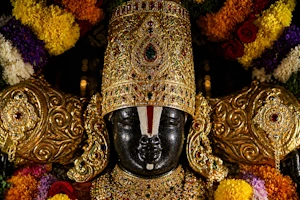
Everyone knows Lord Venkateswara is rich.
But shastra says something shocking.
He is in debt.
Not symbolic. Real, ongoing, cosmic debt.
When Bhagavan descended as Venkateswara on Tirumala, it was not a casual avatar.
He came with a purpose — to live like a king among humans.
But here is the twist.
To marry Padmavati, Bhagavan did not display divine wealth.
He borrowed money.
From Kubera.
A massive loan.
For the wedding.
Now understand this carefully.
Why would Bhagavan borrow?
Why not just create wealth?
This is where the depth comes.
He deliberately chose to enter the system of karma, exchange, and responsibility.
He signed a cosmic agreement:
He will repay the loan…
through the offerings of devotees.
That is why Tirupati is not just a temple.
It is a running transaction between humans and Bhagavan.
Every coin dropped in the hundi
Every offering made
Every vow fulfilled
— it is said to go toward repaying that divine debt.
But here is the deeper, almost hidden layer.
The debt is never meant to finish.
Because if it finishes, the relationship ends.
So Bhagavan keeps the system alive.
You give.
He gives.
You come again.
He calls again.
This is not charity.
This is participation in a divine economy.
You are not donating.
You are becoming part of Bhagavan’s leela.
And look at the psychological brilliance here.
People feel:
I gave to Bhagavan.
But the truth runs deeper:
Bhagavan created a way
for you to feel connected
through giving.
That is why Tirupati never becomes irrelevant.
Empires fall. Systems change.
But this flow continues.
Unbroken.
The Unseen Side
People go thinking:
‘I will ask for wealth, success, relief.’
But the real shift happens quietly.
They start giving.
And something inside loosens.
Attachment softens.
Ego bends.
Flow begins.
That is the greatness of Balaji.
He stands there — not as a distant Bhagavan.
But as one who entered human reality fully.
Even taking a loan.
Q&A for deeper understanding
Why would Bhagavan take a loan when He owns everything
Because ownership is not the point. Participation is. Bhagavan enters human life not to display power, but to establish a system humans can relate to. Debt creates continuity. Continuity creates connection.
What actually reaches Bhagavan when we offer money
Not the currency. The intention behind it. The act of giving shifts the inner structure of the giver. The external offering is only the visible layer. The inner loosening is the real transaction.
If the debt is real, why is it never fully repaid
Because closure ends the relationship. This system is designed to remain open. It keeps the cycle of approach, offering, and return alive across generations.
Why is Kubera involved in this leela
Kubera represents structured wealth. Not random abundance. By borrowing from Kubera, Bhagavan anchors this system into order, accountability, and balance, not miracle-based chaos.
Why do people feel compelled to return to Tirupati again and again
Because the exchange is not one-time. Each visit deepens the connection. The place pulls because the transaction is ongoing at a subtle level, not just physical.
What changes in a person who participates in this system regularly
The grip of ‘mine’ weakens. Giving becomes natural. Fear around loss reduces. Gradually, the person shifts from holding to flowing.
Is this system only about money
No. Money is just the easiest medium. The real system is about offering — time, effort, ego, attachment. Money becomes the visible doorway.
Objections and replies
This is just a myth to collect money from people
If it were only about collection, the system would collapse when belief weakens. But it has sustained across centuries, cultures, and changing economies. That indicates something deeper than a constructed story.
Bhagavan needing money sounds illogical
Correct. Bhagavan does not need money. The system is not for His need. It is for human transformation. The form looks material, the purpose is psychological and spiritual.
If people stop giving, will Bhagavan remain in debt
Yes. And that is exactly the point. The system is not dependent on completion. It is designed to remain open, inviting participation rather than forcing closure.
Why involve wealth at all? Why not pure devotion
Because most people operate through tangible action. Abstract devotion is difficult to sustain. Offering creates a physical expression of an internal state.
Is this different from any other temple donation
Yes. Most places accept offerings. Here, the entire identity of the temple is built around a continuing transaction. That makes the psychology and engagement fundamentally different.
Isn’t this encouraging transactional devotion
It appears transactional at the surface. But repeated participation slowly dissolves the transactional mindset itself. People begin by asking, but many end up just offering.





English
Glory of Venkatesha
Click on any topic to open
7
30
Astrology
Bhagavad Gita
Bhagavatam
Bharat Matha
Devi
Devi Mahatmyam
Ganapathy
Garuda Puranam
Glory of Venkatesha
Hanuman
Kathopanishad
Mahabharatam
Mantra Shastra
Mystique
Practical Wisdom
Purana Stories
Radhe Radhe
Ramayana
Rare Topics
Rigveda Explained
Rituals
Sages and Saints
Shiva
Spiritual books
Sri Suktam
Story of Sri Yantra
Temples
Vedas
Vishnu Sahasranama
Yoga Vasishta
26
17
10
0


