Alternatives to Shodasha Upachara Puja
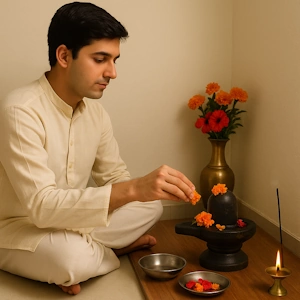
We have been seeing about the Shodasha Upachara Puja of Lord Shiva,
which is one of the methods of regular daily worship of the Lord.
Puja, as Shiva Purana says, is yatah shakti —
not that this is the only method, or that this is the only way you should do it.
Otherwise, God will not be happy.
There are many methods, many alternatives — some simple, some different.
We have already seen one of the simplest methods of daily worship:
Keep a cup of water near God, apply chandana,
offer a few flowers — even one or two — saying whatever mantra or shloka you know.
Light an agarbatti, light a lamp.
Offer some naivedya, a fruit or some dry fruits, or whatever you cook at home in sattwik way.
This is the simplest puja, daily puja.
There are more options given in Shiva Purana.
If you can’t do all the steps, skip Avahana, Asana Samarpana.
Start from Arghya and finish by giving Naivedya.
You can skip Tamboola, Neerajana, Namaskara, and Visarjana,
which are the steps towards the end.
Or do Abhisheka, offer Naivedya, Namaskara, and Tarpana.
Meaning Arghya, Padya, Dhoopa, Deepa — all those steps are not there.
What is Tarpana?
Tarpana is done with water or milk.
Take either of these in your palm and allow it to fall into a vessel through the tips of your fingers,
saying the Lord’s mantra: Om Namah Shivaya, and at the end of it: Parameshwaram Tarpayami.
This is the Tarpana Vidhi.
You can do it five times or eleven times.
So Shiva Purana is not just stories about His greatness.
It gives you so much knowledge about how to worship Him,
how to please Him.
If you are not able to do any of these, then there are more options:
Give puja materials in any Shiva temple — like chandana, bhasma, flowers, oil, ghee, rice for naivedya, jaggery,
or even vessels, bell, lamp used in puja.
Or give a Shiva Linga as dana to a Shiva bhakta.
Or give him mulya of Shiva Linga — value of Shiva Linga — so that he can procure it and start worshipping.
Basically, sponsor somebody’s worship.
You can’t afford these?
Just go to the temple, take His darshana, offer pradakshina and namaskara.
You are at a place where there is no Shiva temple, there are no Shiva bhaktas also — what to do?
Chant Pranava or Omkara 10,000 times a day.
Don’t have that much time?
Do 1,000 times each at the two Sandhyas — morning and evening.
Or Panchakshara Mantra.
Mantra you can chant in three ways:
-
Vachika — aloud, like others can also hear you chanting
-
Upamshu — only your tongue and lips would move while chanting; you can hear, others won’t be able to hear
-
Manasika — only internal chanting
If your mind is quiet, you are familiar with the state of Samadhi, then you can do Manasika Japa.
But if your mind is not quiet, completely quiet,
then you should not do Manasika Japa.
You should do Upamshu Japa only.
This is what Shiva Purana recommends for regular Sadhakas.
Upamshu Japa of Panchakshara Mantra, not mental japa.
Upamshu Japa is 100 times more powerful and effective than loud chanting.
This applies to both Omkara Japa and Panchakshara Mantra Japa.
There are more rules about Sadhana of Panchakshara Mantra, which we will see later.





English
Shiva
Click on any topic to open
7
30
Astrology
Bhagavad Gita
Bhagavatam
Bharat Matha
Devi
Devi Mahatmyam
Ganapathy
Garuda Puranam
Glory of Venkatesha
Hanuman
Kathopanishad
Mahabharatam
Mantra Shastra
Mystique
Practical Wisdom
Purana Stories
Radhe Radhe
Ramayana
Rare Topics
Rigveda Explained
Rituals
Sages and Saints
Shiva
Spiritual books
Sri Suktam
Story of Sri Yantra
Temples
Vedas
Vishnu Sahasranama
Yoga Vasishta
26
17
10
0


