All Manus Are Forms of Sri Hari
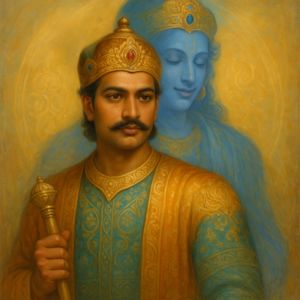
मनुः – मननात् मनुः – because he meditates, contemplates, the whole universe is born, sustained and withdrawn out of his meditation, contemplation.
Manu also means mantra – the essence of all mantras, the deity whom all the mantras address.
The universe is not permanent, it comes and goes.
Brahma also takes birth and dies. Brahma has a fixed longevity. This is called maha kalpa.
When Brahma dies, there is a pralaya called maha pralaya. Brahma lives for hundred years in his own time scale. In another time scale it is also said to be 120 years.
One day of Brahma is called a kalpa.
This is 4.32 billion human years.
Kalpa is divided into fourteen parts and each part is ruled over by a Manu.
One such period or period of rule of a particular Manu is called manvantara.
In one manvantara 71 chaturyugas or mahayugas are there.
One chaturyuga means a set of satya – treta – dwapara and kali yugas.
Every yuga is a repetition of the same series of events and incidents.
It is like a movie show repeated again and again. Story doesn’t change, characters don’t change.
This is why it is said, Anjana Devi told Lord Hanuman about Sree Rama’s story and he was inspired by that, wanted to serve the Lord inspired by this story.
Lord Rama was not even born, where did the story come from?
From the previous chaturyuga, story is the same, same events are going to repeat.
Same Ravana, same abduction of Seeta Mata, crossing of the ocean, Lanka dahana, everything will repeat as it is, like the next show of the movie.
The manvantara is also the period of existence of a set of devas like Indra, Chandra.
Positions are permanent – but the occupants change.
That is why we say Indra padavi – Indra is a position.
At the end of the present manvantara, the present Indra would go and Mahabali would become the next Indra, Maha Bali who is at present in pathala would become the next Indra.
The names of the fourteen Manus, the rulers of the manvantara are: Swayambhuva, Swarochisha, Uttama, Tamasa, Raivata, Chakshuasha, Vaivaswata, Savarin, Daksha Savarin, Brahma Savarin, Dharma Savarin, Rudra Savarin, Deva Savarin and Indra Savarin.
The present Manu is Vaivaswata.
The next Manu will be Savarni, brother of Sani Deva, son of Surya and Chhaya.
All these Manus are just aspects of Sri Hari. He himself.
That is why Sri Hari is called Manu.
So, Manu has three meanings – meditation which is he himself, mantras – all mantras are himself, and the fourteen Manus.
All these Manus are just aspects of Sri Hari. He himself.
That is why Sri Hari is called Manu.
So, Manu has three meanings – meditation which is he himself, mantras – all mantras are himself, and the fourteen Manus.
-
If roles like Indra change while the position stays, what does that teach me about my job and family roles?
Do your role with excellence, hold it lightly, and prepare the next person. Titles rotate, character stays. At home, mentor your children and caregivers the same way so continuity remains even when you step back. -
If events repeat across ages, is my effort pointless or powerful?
Powerful. Patterns repeat, but your response is the arena of grace. Bhakti to Sri Hari turns repetition into refinement. Same waves, stronger swimmer. -
How does thinking in kalpa scale reduce my daily stress?
It shrinks problems to size. When you see time as vast, you stop overreacting to one setback and return to steady prayer, disciplined work, and service. Calm returns faster. -
What is the practical use of knowing there are fourteen Manus?
Governance is structured and purposeful, not random. Bring that structure home: clear duties, honest accounting, and a daily rhythm anchored in remembrance of Sri Hari. -
If Sri Hari is behind creation, sustenance, and withdrawal, how do I align my routine with that flow?
Create mindfully in the morning, sustain responsibly through the day, withdraw cleanly at night with gratitude and short introspection. Three phases, one devotion. -
Does the idea that positions outlive occupants make me less anxious about aging and illness?
Yes. Your value is not erased by a weaker body. Pass on know-how, bless successors, and keep your heart fixed on Sri Hari. Dignity stays even when capacity changes. -
What does manvantara scale discipline look like in 30 minutes a day?
Five minutes silent remembrance, ten minutes mantra japa, ten minutes focused duty without distraction, five minutes service call or message. Small cycle, big stability. -
How does mantra help physical health without turning religion into a hack?
Steady japa settles breath and heart rate, reduces agitation, and improves sleep quality. You do it for Sri Hari, and the nervous system thanks you. Devotion first, benefits follow. -
If stories repeat, why read and retell them at home?
Because memory needs rehearsal. The same Ramayana scene meets a new heart each time. Families bond, children learn courage and restraint, and adults reset their moral compass. -
What does it mean that Sri Hari is called Manu for my inner life?
Meditation, mantra, and righteous stewardship have one center. Keep your mind on Sri Hari whether you are planning, speaking, or leading. Unity inside, clarity outside. -
How do I translate ‘Indra is a position’ into leadership at work?
Build systems, not cults. Document processes, share credit, and prepare backups. When you move on, the team runs better and your name stays clean. -
If every yuga repeats, how do I break my bad personal cycle?
Insert bhakti at the trigger. When the old habit calls, answer with a short nama and one alternative action. Same situation, different allegiance. -
What do I teach children from the idea that even Brahma has a lifespan?
Respect time, use it well, and do not worship status. Teach them to pray, learn, and serve, because even the highest roles are measured by how they were held. -
How does this worldview guide care for a sick family member?
Accept roles as sacred postings. Do duties steadily, lean on daily prayer for stamina, and rotate caregivers. The post matters, but kindness inside the post matters more. -
Is repetition boring or beautiful in spiritual life?
Beautiful. Like sunrise. Bhakti turns the known script into a living meeting with Sri Hari. The heart deepens, even if the chapter is familiar. -
What do I do when setbacks feel like karma loops I cannot exit?
Change what you feed the loop. Offer one act of service, one honest apology, and one round of nama today. Loops starve when you stop supplying the old response. -
How do I carry this cosmic view into my finances and chores without becoming spaced out?
Keep a ledger, keep a lamp. Track money and tasks precisely, and begin each with a short remembrance. Precision on paper, devotion in the heart. -
What is a simple household ritual that reflects creation, sustenance, and withdrawal?
Light a lamp at dawn, keep a clean work surface through the day, and close with a short reading and gratitude. Three acts, one thread to Sri Hari.





English
Vishnu Sahasranama
Click on any topic to open
7
30
Astrology
Bhagavad Gita
Bhagavatam
Bharat Matha
Devi
Devi Mahatmyam
Ganapathy
Garuda Puranam
Glory of Venkatesha
Hanuman
Kathopanishad
Mahabharatam
Mantra Shastra
Mystique
Practical Wisdom
Purana Stories
Radhe Radhe
Ramayana
Rare Topics
Rigveda Explained
Rituals
Sages and Saints
Shiva
Spiritual books
Sri Suktam
Story of Sri Yantra
Temples
Vedas
Vishnu Sahasranama
Yoga Vasishta
26
17
10
0


