Akrura
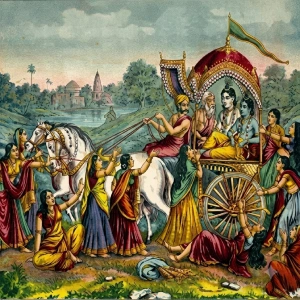
Akrura was an important member of the Yadava dynasty. He was considered as the paternal uncle of Shri Krishna. His wife was Ugraseni, the sister of Kamsa. Akrura was a member of Kamsa’s royal court.
Akrura was one of Krishna's greatest devotees. He is often mentioned as an example of Vandana Bhakti among the nine forms of devotion.
When Kamsa failed to kill Krishna through various means, he devised a cunning plan. He organized a martial arts competition called Dhanur Yajna in Mathura. He invited Krishna and Balarama to participate, intending to have them killed by wrestlers. Kamsa entrusted Akrura with the task of bringing Krishna and Balarama from Gokula to Mathura with respect and honor.
Akrura always longed to see Bhagavan. This opportunity, though orchestrated by Kamsa, was granted by Bhagavan himself. One can only approach Bhagavan with His permission.
Akrura set out early in the morning from Mathura to Nandgaon with his chariot, thinking, “Today, I will see the beautiful form of my Bhagavan with my own eyes. Krishna will come running to me and lovingly talk to me.”
When he reached Vrajabhumi, he saw Krishna’s footprints. Overwhelmed with joy, Akrura jumped off the chariot, rolled on the ground, and immersed himself in the dust of Bhagavan's feet.
Upon reaching Gokula, Krishna and Balarama embraced Akrura and took him to their home. The next day, the three set out for Mathura. On the way, Akrura stopped by the Yamuna for his daily rituals. As he entered the river, he saw Bhagavan’s reflection in the water. When he turned back, Bhagavan was still seated on the chariot. When he looked into the water again, he saw Bhagavan’s form there too. Akrura realized that Shri Krishna was the omnipresent Supreme Soul.
The place where this divine vision occurred is known as Akrura Ghat, located between Mathura and Vrindavan.
After reaching Mathura, Akrura invited Krishna and Balarama to his house. Krishna told him that he had come to end Kamsa's life and would visit him afterward. After killing Kamsa, Krishna visited Akrura’s house, where he was worshipped and honored. Krishna then instructed Akrura to go to Hastinapura and gather information about the Pandavas.
When Krishna and the Yadavas moved to Dwarka, Akrura accompanied them. It is said that no drought, famine, or hardship would occur wherever Akrura resided. Once, when Akrura left Dwarka for some time, the people suffered greatly. Krishna promptly summoned Akrura back to Dwarka.
Finally, Akrura attained Bhagavan’s divine abode.
- How does Akrura's association with Kamsa contrast with his inner spiritual state, and what profound principle does this illustrate?
Although Akrura was a member of Kamsa's royal court and was married to Kamsa's sister Ugraseni, his inner state was deeply absorbed in devotion to Shri Krishna. This illustrates the principle that true devotion and spiritual purity remain entirely untainted by worldly associations, political obligations, or oppressive environments. - What specific form of devotion is Akrura famous for, and how does his physical reaction in Vrajabhumi demonstrate the greatness of this principle?
Akrura is celebrated as the supreme example of Vandana Bhakti, which is the devotion of respectful obeisance and prayer. The greatness of this principle is demonstrated when he sees Krishna's footprints in Vrajabhumi, leaps from his chariot, and rolls in the dust, showing that true reverence requires the complete surrender of ego. - What philosophical realization did Akrura have regarding his journey, revealing a hidden truth about encountering the divine?
Akrura realized that although the command to bring Krishna to Mathura came from the wicked Kamsa, the actual opportunity was orchestrated by divine grace. This reveals the hidden truth that a soul can only approach Bhagavan when the Supreme Lord Himself grants the permission and calls the devotee. - What was Kamsa's actual motive behind organizing the Dhanur Yajna, and how did it unintentionally serve the ultimate divine plan?
Kamsa organized the Dhanur Yajna as a deceptive martial arts competition, intending to have Krishna and Balarama killed by his wrestlers. However, this wicked plan unknowingly served the divine purpose by bringing Krishna directly to Mathura, setting the stage for the eradication of evil and the liberation of the people. - Describe the mysterious event that occurred at the Yamuna river and the profound cosmic reality it unveiled to Akrura.
While performing his rituals in the Yamuna, Akrura saw the reflection of Bhagavan in the water, yet when he turned back, Krishna was still seated on the chariot. Seeing the divine form in both places simultaneously unveiled the mysterious cosmic reality that Shri Krishna is the omnipresent Supreme Soul, pervading all of creation. - By what name is the location of Akrura's mystical vision known today, and how does it serve as a geographical anchor for this divine event?
The sacred location where Akrura experienced the omnipresent vision of Bhagavan is known as Akrura Ghat. Situated perfectly between the holy regions of Mathura and Vrindavan, it serves as a permanent geographical reminder of the transition from the pastoral pastimes of Gokula to the royal duties of Mathura. - Why did Krishna decline Akrura's initial invitation to visit his home, and what does this reveal about the priorities of Bhagavan?
Krishna declined the immediate invitation because His primary mission was to eliminate Kamsa and restore righteousness. He promised to visit Akrura only after completing this task. This reveals the principle that the Supreme Lord prioritizes the establishment of universal dharma over personal comforts or immediate social pleasantries. - What important diplomatic responsibility did Krishna entrust to Akrura after visiting his home, highlighting Akrura's overlooked political acumen?
After honoring Akrura with a visit to his home, Krishna instructed him to travel to Hastinapura to gather information regarding the well-being and circumstances of the Pandavas. This highlights an often overlooked aspect of Akrura: beyond being a pure devotee, he was also a trusted and capable diplomatic emissary. - What was the supernatural and mysterious influence of Akrura's physical presence in a kingdom, as observed during his time in Dwarka?
The mysterious influence of Akrura's presence was that his pure devotion generated immense material and ecological harmony. Wherever he resided, the land was completely protected from droughts, famines, and hardships. When he temporarily left Dwarka, the region immediately suffered, proving that the presence of a pure devotee sustains the prosperity of society. - What was the final spiritual culmination of Akrura's life, and what eternal message does it leave for followers of the devotional path?
The final culmination of Akrura's life was his attainment of Bhagavan's divine abode. This leaves the eternal message that a life lived with unwavering Vandana Bhakti, complete surrender, and dedicated service ultimately leads the soul out of material bondage and into the eternal presence of the Supreme Lord.





English
Purana Stories
Click on any topic to open
7
30
Astrology
Bhagavad Gita
Bhagavatam
Bharat Matha
Devi
Devi Mahatmyam
Ganapathy
Garuda Puranam
Glory of Venkatesha
Hanuman
Kathopanishad
Mahabharatam
Mantra Shastra
Mystique
Practical Wisdom
Purana Stories
Radhe Radhe
Ramayana
Rare Topics
Rigveda Explained
Rituals
Sages and Saints
Shiva
Spiritual books
Sri Suktam
Story of Sri Yantra
Temples
Vedas
Vishnu Sahasranama
Yoga Vasishta
26
17
10
0


