Aavartano nivrittaatmaa ...
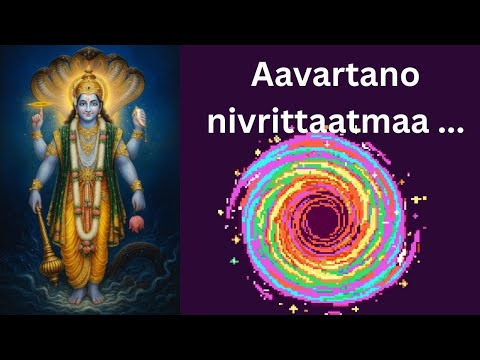
आवर्तनो निवृत्तात्मा संवृतः सम्प्रमर्दनः ।
अहः संवर्तको वह्निरनिलो धरणीधरः ॥ २५॥

aavartano nivrittaatmaa samvritah sampramardanah
 ahah samvartako vahnir anilo dharaneedharah
1. आवर्तनः (Aavartanaḥ) – The Cycler, The Revolver of Time
He is Aavartana — the One in whom all things turn,
the wheel of time, the spiral of creation, the rotation of destiny.
He is the unseen churning of the cosmos —
where stars are born, destroyed, and reborn.
Your lifetimes, your joys, your returns —
all ride His rhythm.
He is the current that carries the boat of existence in circles —
till you learn to cross over.
2. निवृत्तात्मा (Nivrittaatma) – The Detached Soul
He is Nivrittatma — the one whose soul has withdrawn,
not out of indifference,
but out of perfection.
He is untouched by outcomes, beyond want, beyond fear.
The storm may rage — but He is the sky behind it.
The world may burn — but He is the coolness within.
He is the silent ascetic in the heart of the king.
3. संवृतः (Samvritah) – The Hidden One
He is Samvrita — the One who is veiled, wrapped, concealed.
You won’t find Him in loud temples alone,
nor in loud intellect.
He hides in stillness, in shadow, in silence.
But to those who truly seek —
He reveals Himself as the golden thread behind the veil.
He is the diamond beneath the dust.
4. सम्प्रमर्दनः (Sampramardanaḥ) – The Total Crusher
He is Sampramardana — the One who doesn’t just defeat —
He obliterates.
Not out of rage.
But to end falsehood at its root.
When demons rise with thousand heads,
when injustice grows thick and proud —
He arrives.
Not with anger, but with unstoppable clarity.
He is the cosmic reset, the breaker of all that must fall.
5. अहः (Ahaḥ) – He Who Is Daylight Itself
He is Ahaḥ — the very day, the bringer of light,
the dispeller of the long night.
He does not merely bring the sun —
He is the sun behind the sun.
When ignorance hides the truth,
He rises like dawn — not loud, but undeniable.
He is hope, clarity, visibility —
the beginning of awakening.
6. संवर्तकः (Samvartakaḥ) – The Cosmic Destroyer
He is Samvartaka — the force that ends a kalpa,
the wind, the fire, the storm of pralaya.
This isn’t blind destruction.
It is the sacred clearing —
the fall of leaves that makes way for spring.
When everything old must die,
He is the noble finisher.
He is not chaos.
He is completion.
7. वह्निः (Vahniḥ) – The Fire
He is Vahni — not just flame,
but the conscious fire.
The fire in yajna,
the fire in your breath,
the fire of tapas,
the fire of love,
the fire of destruction.
He purifies.
He digests.
He transforms.
He is the sacred blaze that burns what must go and cooks what must grow.
8. अनिलः (Anilah) – The Wind, The Breath
He is Anila — the wind, the movement, the breath of the universe.
You don’t see Him —
but you live because of Him.
He flows through the trees, the lungs, the mantras.
He is life, rhythm, vitality — always moving, always present.
You take Him in with every breath,
yet never notice —
that is His grace.
9. धरणीधरः (Dharaneedharaḥ) – The Holder of the Earth
He is Dharaneedhara — the One who holds the world up,
not on His shoulders — but within His will.
Mountains do not crush Him.
Civilizations do not burden Him.
Karma does not shake Him.
He carries the cries of the fallen,
the songs of the faithful,
and the weight of sins without strain.
He is the invisible pillar beneath all that stands.
This verse isn’t a lullaby.
It’s a cosmic reckoning — a reminder of the One who stirs the wind, burns the rot, breaks the lies, and sustains the truth.
Aavartana. Nivrittatma. Samvrita. Sampramardana. Ahaḥ. Samvartaka. Vahni. Anila. Dharaneedhara.
Each name is a force.
Each name is a cleansing.
Each name is a call to surrender — and stand strong.
-
What changes when I see time as cyclic rather than a straight line?
You start spotting repeating patterns and stop panicking at setbacks. Progress becomes rhythmic, not frantic. Chant the full Sahasranama at a slow pace; its cadence trains the mind to flow with cycles instead of fighting them. -
Is 'cycler of time' anything more than poetry? Show me the logic.
Nature runs on loops: days, seasons, orbits, growth and decay. The nama encodes this law of recurrence and says the ultimate order behind those cycles is one. It is not a new physics claim; it is a framing of what already repeats everywhere. -
Can true detachment make me warmer with family instead of cold?
Yes. Non-clinging frees attention for steady care and fair decisions. You act without the itch to control outcomes, which removes friction at home and at work. -
Is detachment just escapism dressed up as virtue?
No. Escapism avoids duty; detachment removes greed from duty. The nama marks inner freedom from compulsion so action becomes cleaner, not absent. -
Why would the highest reality stay hidden instead of announcing itself?
Because noise buries signal. Silence, conscience, and honest work are quiet channels; truth meets you there. When craving drops, recognition is immediate and stable. -
If it hides, how can any claim about it be verified?
By effects that stay: steadier judgment, lower envy, durable compassion. These outcomes are observable over time and resist faking. The nama points to a source whose presence explains those changes without theatrics. -
What does a 'total crusher' mean for stubborn lies and addictions?
It means falsehood ends at the root, not dressed up or negotiated with. Inner clarity smashes the excuse-engine so the mind stops recycling the same trap. Chant any nama from the Vishnu Sahasranama 108 times when you need a hard reset. -
Isn't 'crushing' just dangerous absolutism?
The target is not people; it is untruth that corrodes order. The nama defines a corrective principle that removes what cannot coexist with justice. It is moral surgery, not rage. -
How is a cosmic finisher compassionate?
Endings clear space for clean beginnings. When rot goes, life breathes again. The nama frames dissolution as completion, not chaos. -
Apocalypse language sounds fear-based. What stops misuse?
The claim is about a cyclic phase change of the cosmos, not a human threat. It gives context for impermanence, not a license for violence. It explains why endings can be orderly, purposeful, and timed. -
What is the 'inner fire' that purifies speech and work?
It is disciplined sincerity that burns away pretense and half-hearted effort. That same fire digests experience, turning pain into wisdom and heat into service. -
Fire is chemistry. Why call it conscious?
Because the tradition names the ordering and transformative role of fire, not a separate substance. The term points to meaning layered on matter: one law that cooks food, fuels sacrifice, and remakes character. -
How does remembering the unseen wind change how I carry stress at home?
You loosen your grip and allow movement. Conversations soften, tempers cool, and routines find rhythm. When time is tight, chant any nama from the Vishnu Sahasranama 11 times to steady the mind before you speak. -
Wind is just air in motion. What is the claim beyond physics?
That life relies on a subtle, given flow you do not control yet constantly receive. The nama honors dependence and gratitude without denying meteorology. It is a moral interpretation of a physical fact. -
What steadiness does 'holder of the earth' give someone paying bills and carrying family duties?
It gives trust that support is real and the ground will hold while you labor. You work firmly, not fearfully, and your care becomes consistent. Chant any nama from the Vishnu Sahasranama 108 times when you need to feel anchored. -
Gravity holds the planet. Why invoke a holder at all?
Because 'holder' names the reliable order that makes gravity, ecology, and society hang together. It is not a literal giant; it is the sustaining intelligence behind stable laws and lasting duties. -
How does 'daylight itself' translate into mental clarity when life feels foggy?
Light makes facts visible and choices simple. Sleep and morning light stabilize mood; honest talk gets easier when things are seen as they are. Chant any nama from the Vishnu Sahasranama 11 times to mark the shift from fog to focus. -
If it is 'day', why do wrongs still happen in broad daylight?
Light reveals; it does not coerce. Daylight exposes fault lines so correction becomes possible. The nama asserts illumination, not immunity from human choices.





English
Vishnu Sahasranama
Click on any topic to open
7
30
Astrology
Bhagavad Gita
Bhagavatam
Bharat Matha
Devi
Devi Mahatmyam
Ganapathy
Garuda Puranam
Glory of Venkatesha
Hanuman
Kathopanishad
Mahabharatam
Mantra Shastra
Mystique
Practical Wisdom
Purana Stories
Radhe Radhe
Ramayana
Rare Topics
Rigveda Explained
Rituals
Sages and Saints
Shiva
Spiritual books
Sri Suktam
Story of Sri Yantra
Temples
Vedas
Vishnu Sahasranama
Yoga Vasishta
26
17
10
0


